Saturday, February 7, 2026

“The Way The Whole Darned Human Solidarity Keeps Perpetuating Itself” One Flew Over The Cuckoo’s Nest, Intentional Distancing, Accidental Empathy, & Rebellion as A Way To Pass The Time

Can selfishness be intersectionally liberating? Can assholes help to free strangers?

Those are two sentences saying the same thing, and I’m being repetitive only because I feel like I’m going to be fighting both of those conflicting impulses while I write this whole thing. Sometimes my philosophy degree is more trouble than it’s worth.

I’d say the same tonal conflict is true for this cinematic masterpiece One Flew Over The Cuckoo’s Nest. At its surface, it’s just a story of a randy-horny good ole boy trying to stir up trouble at a mental institution and have some fun, until he gets smashed by some know-it-all in a white doctor’s gown who’s never known real human joy in her whole suffering life. On the other hand it’s a weighty allegory for the challenges and depths and risks of human freedom, with undercurrents of messianic allusions on the main character.

But all these things have already been written about this movie & book (I know, I read most of them; I was nuts about this book & its author Ken Kesey for quite sometime in college—Hunter S. Thompson too obviously; I must obey the inscrutable exhortations of my basic-ass white boy soul). Other than the old things about this movie, what is new about it—obviously not because the movie has changed, but without changing is the movie still pertinent to modern age? Do we have new characters currently that are reflected in the old characters back then, falling into a future that the creators from decades ago were unknowingly reflecting now, because time & its art is a pair of flat stupid circles?

Worth first obvious mention—it’s always been cool to not trust the government & to piss off authority. But why is Randle Patrick McMurphy so much more whimsical about his rebellion than the current crop of illiterate face drooling plague rats we’ve been cursed with? Was it just “the 60s?” I’m going to say, probably not. I’m willing to bet my last 41-year-old Square dollar that there were more than enough jingoistic racists floating around San Francisco & Woodstock. They were just luckily never in charge of the microphones & bullhorns.

But upon my contractually obligated re-watch in order to weave this essay, I’m struck with how OFOTCN can still act as a skeleton key of some sort for our current fascist malaise, at least as far as recruiting the unrecruitable & accidentally helping the ignored and marginalized without direct intent. What if being a bored, selfish cur with ADHD and a deck of porno playing cards was a legitimate route to metaphorically knocking down the walls for everyone else on your way out of the smashed windows you shattered on your way to Canada?

As far as first monikers go, it’s important to mention that Randle Patrick McMurphy is initialized to RPM—revolutions per minute, which you might accuse me of being cheeky except for the fact that Ken Kesey has mentioned in numerous interviews that he intended that directly as Revolutions Per Minute, which is somehow both the most subtle and also the most ham-fisted thematic metaphor I’ve ever read. The Randle character is intended to be a living avatar of the aphorism from Albert Camus (an author even better than me & Ken Kesey combined, if you can believe that), “The only way to deal with an unfree world is to become so absolutely free that your very existence is an act of rebellion.” That’s all a given, that’s symbolically presented on a silver platter for anyone watching the movie. That part’s easy. My question is, can a character who’s living all this freedom only for themselves inadvertently foment the liberty, freedom, and independence of those around him without even trying, or in fact even giving a shit? Like a rising tide in a leather jacket that accidentally also lifts all the boats around it.

The movie wastes no time letting us know that RPM thinks quite highly of himself. He’s a “marvel of modern science” when the doctor asks him if he thinks there’s anything wrong with himself. Certainly an answer drenched in shamelessness and self-acceptance, obviously contrary to the entire energy of the literal building and all its inhabitants and staff and tiles and formica and glass and concrete right down to the foundation. He’s so irrefutably chipper about (only) himself, that even when he fails to lift the sink in the wash room, he drops the utterly savage line that “I tried didn’t I? God damn it at least I did that” right in the faces of all the men who just watched him fail. Even failure is a victory for his irrefutable faith in himself. A victory while stuck in this emotional gravity sink of an edifice ergonomically designed to make its inhabitants hate themselves.

But for the whole first half of the movie, we can tell he’s only doing any of this for himself. Out of boredom. To kill time since it’s saving him from the work prison. And anything that contributes to that boredom is verboten to him. That’s his only priority. He doesn’t want to watch the World Series because it’ll “help the boys” and “their struggle is his struggle.” It’s because he just likes baseball. He hasn’t thought any further than that. The same is for his “bet” to wind up Nurse Ratched until she doesn’t know whether to “shit or wind her wrist watch.” As if he needed the boys to egg him on. He would have hassled her for free without an audience. He’s not taking on a Goliath in order to “pursue intersectional liberty for his fellows in solidarity with their incarceration.” He’s bored out of his ass. And he’s likewise shortsighted enough that he doesn’t even consider that there might be consequences (for himself) to his 24/7 game of treating human beings like his own personal fidget spinners.

This is ramped up & revealed at the group therapy session near the middle of the film, which devolves into a screaming match, smashed windows, and a riot for cigarettes. Blowing well beyond Ratched’s control, and Randle finally for once understanding there are stakes here that he hadn’t noticed up until then. This is reiterated when they take Cheswick away for electroshock therapy; RPM isn’t exactly consoling. He mostly feels confused & hassled that Cheswick is holding on to him for dear life. But he immediately wakes back up when Chief Bromden reveals that he’s been playing a fast one on the whole building by only pretending to be deaf & mute.

And this is the beginning of RPM learning to care. When he has a friend. When he has someone keeping his own secret, that he shares with RPM. Chief Bromden is the introverted version of the Camus quote—he is living in pure rebellion every second of every day to every single person around him. And the honor he bestows on RPM by letting him (and only him) in on it. And RPM is literally giddy AND flattered. Someone had one over him, even HE thought Chief was a deaf mute. RPM is ecstatic to be outsmarted by someone else for once. Someone else is running a grift. Now he’s not a solitary grifter. And the loneliness of that lifestyle– marching to your own drum can be exhausting if no one else hears the music—finally punctured by one person who’s finally doing the same thing he is.

Now this sets us up for the second half of the movie, when RPM actually starts taking an engaged interest in the other lunatics. He actually cares about their development. Having one friend actually taught him how to care about everyone else. The re-introductory scene begins first with Sefelt lying to Nurse Ratched to cover ass for Fredrickson—reminding us that friendship can be two people willing to lie to other people for each other (especially to the cops). Then the first wink to Chief Bromden from RPM before revealing his newly electrically invigorated mental health to the rest of the Mental Defectives.

You’re all adults with impeccable cinema tastes, so I know you’ve all seen the movie already, so we all already know how the story plays out (with the book actually ending with all the self-committed inmates actually electing to set themselves free, which nicely plays into my theme much better, thanks Mr. Kesey). What’s important here is that we have no indication that RPM is, let’s say, woke enough to explain what he was doing or why he was doing it. RPM is many things, but I don’t think “reader” is one of them. I don’t think he’s read Marx, he does not understand praxis, solidarity, or any of the other utterly insufferable lexicon from the Communist Reader at my feet covered in sand grains from my one-eyed pirate cat’s shit box. RPM did not need–and in fact would not have sat still for—any intellectual convincing, and a library card would have been wasted on him. As I said before, he didn’t even register “wrongdoing that required heroic rectitude!” He was just dying of boredom. And he didn’t know boredom was everyone’s problem until he had made a friend. And he doesn’t know that boredom can actually give you a mental illness—he’s been lucky enough (to be born with enough moxie & born white– let’s not pretend that doesn’t buy him leeway with authorities) to be able to fight against it his whole life. And most control-cultures have a vested interest in making their inhabitants bored: I’m reminded of La Haine where boredom literally leads to paranoia and violence, which is lashed out upon one’s surroundings and fellow travelers in your immediate vicinity—it almost never goes up the chain of command. This is shown in OFOTCN in the first group therapy session, when the inmates are egged on to verbally attack each other, instead of unifying against The Nurses—one of the course-corrections that RPM eventually, inadvertently, drives them towards with his ne’er do well-ery.

But by the end of the movie, does all this actually portray an actual change of heart for RPM? I don’t know. True to form, I don’t even think he knows. He sits in the chair, waiting for Billy to finish banging Candy. Does he care? Is he perturbed? Is he thinking desperately about how to save everyone else? Is he just too drunk to climb out a window and just needs to rest his eyes for a minute? After Billy dies, why does RPM try to choke out Nurse Ratched? Is it “for Billy”? Is it because he feels guilty for Billy’s death and he’s projecting? Is he just sick of her always telling everyone to remain calm? Who knows. All we know is that it happened. It’s what his reflexes told him to do. And they’ve got him this far in his life, and you dance with who brought you, so he followed through on them. I wouldn’t even say “consequences be damned,” because that implies he even considered those at all, which we know is not his forte, to say the least.

Then the denouement at the end of it all. The Nurse’s neck brace (showing she’s not invincible). The lobotomy. Chief Bromden’s act of rescue (there’s a wonderful little quick cut-in shot where Chief is undoing his own bed straps by himself, just to cinematically remind you of RPM’s influential effect on those around him). Chief breaking the sink off its foundations, setting the water free from the pipes & himself free from the window. But it’s ultimately Chief’s liberatory act of murder, his reciprocated endowment of freedom back onto RPM that is the greatest act. The smashed window leaves a path for the other inmates, but whatever has happened to all of them, because of RPM, will spread to anyone else they run into, for the rest of their lives. Solidarity doesn’t begin to describe it. It’s more like a pathogen they caught from him, that you use as a vaccine to fight the greater disease of boredom. They’re all inoculated now.

Texas Chainsaw Massacre: Hippie Road Trip Masterpiece (Film as a Self-Care Text About How It’s Totally Fine to Go No Contact With Your Family)

Pulled pork tacos were a poor choice.

That was my first thought when I started this movie. After the opening flash photography montage depicting half-decomposed human bodies, leading into the zoom-out reveal of a pair of putrefied corpses mangled and reassembled into a fetish totem, I was temporarily put off my protein entrĂ©e for my movie dinner. Thinking back, I can’t recall too many movies that began with my full attention gripped as immediately as The Texas Chainsaw Massacre. There is no curiosity. There is no mystery. “I wonder what this movie is about” is not a thought that crosses your mind. This movie is about evil. Its every frame is a painting, if the paintings were done by Francis Bacon.

Being that this was only my second time seeing it, everything was still fresh and horrifying enough to write about. But now with just enough breathing room to Think About What It All Means, it is about a great many things. Like all great art, it can be a great many number of things, but for the interest of this essay, we’re just going to lock in on how this movie is a seminal text in the hippie ethos culture, specifically how your parents are square and their lives are bullshit. The most terrifying thing in the American Mythos is the Family Unit. The horror lies in not escaping the hive. It’s like a Faulkner novel, but with chainsaws.

Our opening, our idyllic setting, our status quo to be shaken by the coming movie nightmare, begins with our penta-protagonists on a road trip to Texas to check on the status of a dead and buried relative—there’s been grave robbings in the area, and they need to check to make sure their grandparent is still interred in the earth (where the dead belong, where they can have no interference with the living). On their departure back to proper civilization, they pick up the Hitchhiker (unbeknownst to them as the first member of the Sawyer Family who’s been doing all the desecrated digging). It’s worth noting the celluloid beauty in that pickup scene. The rolling one cut scene, which has the van slowing to a stop and the Hitchhiker climbing into the van, is shot with the greatest rolling cinematic vista in the film up to that point so far, and even from then on. After that one moment of showcasing the great breathing windswept natural open freedom that is America, beginning immediately after that very moment that they pick up the Hitchhiker, from then on it is all claustrophobia and decay and dead brush and dried up river beds and murder and massacre.

All fecundity begins to expire once they interact with a Traditionalist, which the Hitchhiker definitely is. He waxes nostalgic and philosophic about how it’s a shame that the local slaughterhouses moved away from the old fashioned skull-hammer-smash meat murder method, and instead embraced the air gun method (even though it’s cheaper, faster, safer, more humane, and leads to better meat that’s not tainted in flavor because of adrenaline from the livestock’s fear of dying—that’s not mentioned in the cinematic text directly, it’s just stuff I happen to know; don’t ask how, you just have to know these things to be philosopher king, you know). All to say, the Hitchhiker is a man who thinks things were better in the Good Old Days. Even though the old way is an inferior idea that leads to an inferior product, the new way lacks cruelty, and that’s the Hitchhiker’s favorite part. At the expense of all other possible economic, moral, and efficiency advantages, the cruelty is the point.

And where do Traditionalists spring from? From where do they breed and breathe and beget their barrenness? From the Home. The Home is little more than an aquarium of preservation, and preservation itself is not an inherent good. Preservation is only preservation, and preservation for the sake of pure preservation leads only to pure rot. But (other than an utterly wicked zoom shot that has the house swallow up the entire frame as the second victim makes her cursed approach) the movie wisely doesn’t make the home the villain, that’d be boring and pretentious. The concept of the Home is just the base for the violent antagonists to be antagonists. These are the Sawyers, and their heirloom is cruelty. Every home is where the preservation of Tradition, the greatest horror, is always perpetrated. A healthy home is made to be birthed in, and then flown away from. Otherwise the blood will pool in the cul-de-sac. Like the bard said: Happy families are all alike, every unhappy family is unhappy in its own way, with chainsaws.

The moral punishment of the 70s that is visited on these free-wheeling road-tripping hippie children is that they had the audacity to leave their homes and to expect that the world, or at least their lives, would be better than what came before them. To be better than what they were escaping. That the 60s had some semblance of imagination, or consideration that maybe the next crop of Americans could set their own boundary on evil and not turn into their parents from the 40s and 50s if they got far enough away. But the slaughterhouse monster snatched them right back in again. It’s like the ending of Easy Rider, except with chainsaws instead of shotguns. America doesn’t like it when you try to change America, even if it’s for the better.

There’s an offhand scene in the third act, where the oldest Sawyer has captured our main heroine and is bringing her back—retrieving the lost sheep who dared to run for freedom—and he’s almost mindlessly pummeling her with his off driving hand, poking her with a large stick while she cries in the potato sack. It’s the purest, most bored sadism. It’s doing nothing of any pragmatism or use. Only the cruelty is the point.

Leading into the Dinner Scene. The clearest and most obvious reflection that the Nuclear Family is the Toxic Family. It’s fair to say that not all families of all time are inherently toxic, but I’d say that was the general assumption coming out of the 60s and 70s, at least for kids Sandy’s age. Any Tradition & All the Houses that Protected It that led to that Vietnam War are found guilty by association, as far as this movie is concerned. All the archetypal members of this macabre meal are accounted for—even Leatherface in his best housewife skin-face, with makeup & lipstick—and the most trapped, incessant, unbearable horror scene of the whole film. All of the heroine’s earlier and luckier friends were allowed to just simply be murdered. She has to sit through actually interacting with her fellow familial inmates. Most importantly for our theme of rot feasting on growth, the scene where they feed the blood cut from our heroine’s hand to Grandpa Sawyer, the desiccated corpse of the past (well overdue for the cemetery) is literally feeding off the vitality of its nation’s youth.

These are the things you get with a family comprised entirely of Traditionalist dead-end losers. Shit always rolls downhill, and with the sun in angry solar flare (“when the earth is having a bad day” to quote the director Tobe Hooper) the bottom of that intergalactic shit hill is the Sawyer’s front door. And the only thing they have on hand to even attempt to maintain some superiority over others is the act of sheer violence; whatever they can do to you that you can’t retaliate, just for the fact that you can’t retaliate is what makes it fun. The cruelty is the point, because they have no other point. They have nothing else going for them, except what they can do to hurt other people, to put people below them. Whomever they are beating and eating, that is who they are winning against, if even for a moment. It’s a Cormac McCarthy book about the inescapable stain of violence burned into the soul of America, but with chainsaws. We already have a movie version of Blood Meridian. It’s called The Texas Chainsaw Massacre.

And it is a cycle. It is each of them hurting each other, and hurting whoever they come in contact with. As the Bible says, hurt people hurt people, with chainsaws. There is no forgiving or fixing a cycle. There is only breaking it. In one regard, it remains unbroken—the sun rises on a new day in America, The Day of Leatherface. The Joy of Cruelty. But Sandy, our heroine, is still alive. And she did not defeat the Sawyer family. She did not redeem, heal, chastise, fix, or accept that cavern of unhinged and violent men. She got in another car and she left. The movie bookends with automobile liberty, the grace and freeing myth that has sustained the best parts of America: to Keep It Moving Somewhere Else & Leave All That Old Shit Behind (it used to be horses, it used to be boats from the Old World to the New One, but the theme still stands). She kept running from what wanted to kill her. There is no fixing a broken family. You are one person. They are legion. There is no resolution of justice, there is only escape. Perpetual forward movement away from what tried to kill you. No forgiveness, no forgetting. There is only movement away.

The Dirty Dozen: Your Dad’s Favorite Movie Before FOX NEWS Got To Him

An ensemble masterpiece, where one dozen of the worst and most violent incarcerated American soldiers are offered a suicide mission in exchange for their freedom. A rotten deal from a rotten wartime government, offered to rotten men, to get them to kill the only type of people even worse than they are–NAZIS.

I was thinking just today, speaking with my yuck-em-up co-workers at my comedy show, about how much more fun art is when it’s big and stupid and loud while being coated over a pertinent social message—which as an aside is why we all picked comedy (“I don’t want to write a 700 page novel about a bunch of boring-ass people getting a divorce” I believe was my actual comparative statement, about why stand-up comedy is the superior mode of artistic expression). I believe this can all be classified under the “medicine with a piece of cheese” type of message delivery. If you make it fun, or funny, or loud, or bright etc. etc., you can get things to sink in to the audience, much better than if you just told them.

All that to say, The Dirty Dozen is one of the greatest pieces of cinematic cheese-wrapping, around one of the most pertinent social messages of the twentieth & (now because we didn’t learn the lesson hard enough) the twenty-first century: NAZIs and fascists will always suck, and anyone fighting them is The Good Guy. Philosophically, a simple premise, but one we’re apparently having trouble remembering. The Dirty Dozen plays a vital role in the delivery of this required social ethic.

Let’s begin with a few premises we all probably agree on (I do only have about 1500 words here):

The Dirty Dozen rules (If you didn’t already think so, why are you reading this? Also get your shit together, this movie rules)

Fascism and NAZIS are bad (You’re reading this, which means you’re literate, which means you’re probably neither of those things, good job you)

A lot of Fascists are The Worst Dudes. They are dudes. They are whiny frightened cowardly little manly mongrels who mess their pants daily and need their bottoms pampered and their media fed to them in little spoons so they don’t hurt themselves.

For the interests of this essay, we’re going to concentrate on how this is a Male Problem. This is pertinent to mention, because this film has almost no Female Speaking lines. There is one German woman with lines, in German, whose only dialogue is calling for a Nazi dude to bone.

This is a misogynist film, designed to reach misogynist dudes, because they need to learn the lessons that this movie has for them. That is the first layer of cheese.

It’s important that you know, I’m not hand-waving all this like “Oh it was a different time.” No, the characters here are awful. They’re violent, simplistic, and dangerous men, incarcerated or otherwise. And as our real-world time continues to go on, “the good guys” in this movie will continue to age more and more poorly, and yet they will still, always be better dudes than the NAZIs they are killing in this movie. This is a remedial film, because apparently there are remedial minds out there who still need it.

“NAZIs bad. America good.”

And when is America goodest, Jethro?

“…when killing NAZIs?”

100%. Gold star.

I yearn for the day that The Dirty Dozen can fade into history’s sad and dusty pages and be forgotten, because we’ll have learned the lessons it had to teach us. But we haven’t, so it doesn’t.

So here we are, still watching The Dirty Dozen. And as medicine wrapped in cheese goes, we could do worse. This movie is funny, it’s fun, it has Lee Marvin being insubordinate, it has prostitutes being prostitutes (“I could only get eight, they’re like cops–when you need one you can’t find them”). It has guns, explosions, knives, punching, obstacle courses, and male bonding. The best homework is homework that doesn’t feel like homework.

My other favorite part of the Secret Homework Wrapped in Cheese for our students is in both how wonderfully underhanded AND overhanded it handles race. Not just in Jim Brown’s black character, but in every character in this Dirty Dozen Colors of the Rainbow Coalition. Greek, Spanish, Polish, Italian, and American Indian (played by a white dude in Redface—not great!) But this is all of course not directly mentioned in the text—about how America is only at its greatest strength when it lives and breathes on its racial diversity—because the people who need to know it will get very scared and sad and whiney if they have to hear it with words. So instead you sneak it in with guns and punching. Not only, obviously, by killing NAZIs. You can also see that Colonel Breed’s antagonist platoon from the American air-drop school are all White-White. Clean cut. Pure, one might say. And Dirty is something to be proud of in this movie, thank you very much.

The most important chess piece in this racial message (my favorite message in this film, that America’s greatest and infinite strength is when it welcomes in all the world’s tired, poor, huddled masses yearning to kill NAZIs), the man who bears the incredible thespian responsibility of playing a convincing and irredeemable asshole, one of the most repugnant cinematic villains I’ve ever seen in movie history, the Judas who must act or we have no counterfoil with which to make our point of racial unity in service of killing Fascists and the righteousness thereof, we have Archer Maggott, played by Telly Savalas with such incredible visceral and evil aplomb that it would not be matched for 45 years until Leonardo DiCaprio in Django Unchained. Archer Maggott, the role turned down by Jack Palance because the director refused to give the character a redemption arc where he “learned his lesson.” Apparently director Robert Aldrich believed some Americans don’t deserve to be invited back. Once you call Jim Brown the n-word, you don’t get to patch that up. And see the clear metaphorical equivalence made in the film, with one scene where Maggott relaxes and plays catch with himself with a grenade, while lying in a palatial king-sized bed in a NAZI chateau. Make yourself at home, Maggott, you fit right in! And all the while throughout the movie before that point, with the incessant religious haranguing from the character, at all times and every opportunity, it’s all a very clear message that Fascists can grow quite easily in local American soil—that the NAZIs who claim to be atheist can have more than enough in common with an American-born Christian. This is symbolically proven most completely when the shooting starts, that Maggott is also the first one shot and killed by a Dirty Dozen-er: Maggott deserves to die in this mausoleum just like the rest of those racist scum.

There are other, greater, and even more beautiful themes and subtleties in this masterpiece. Cinema things are going on that can teach you about the union solidarity of communism, and who holds the power of death (first used as a threat against the Dozen, then stolen by the Dozen as The Power of Desperation & its Leverage—if they’re going to die anyway why do they have to follow your orders?) But that is all pretentiousness from a philosophy major. That would all be gilding the lily. The central message, and the exploding cheese around it, is already perfect for those who must learn it. There is no “greater message” behind the Front Message of the film, because it is already the Greatest Message—kill NAZIs, get out of prison. Don’t be a fascist, be the good guys.

Who are the Good Guys?

Anyone who’s not a Fascist.

Wednesday, September 3, 2025

“Will the Real 80s Action Movie Please Blow Up” — 80s Avarice & Film False Positives

 The allure of mystery is inescapable in the upcoming quadruple lineup for the 80s ACTION EXTRAVAGANZA II: THE QUICKENING. We do not actually know what the movies in question will be. I tried to find any info about the first extravaganza, but even after a righteous session of Google-fu, I was able to find the posting regarding the actual premier event, but no information about what movies ended up being shown that first year. So we can’t even narrow down our possibilities with any information about round one. Only the Trylon knows where the bodies are buried on this one.

So how do we predict the uselessly predicted? Obviously someone knows the true answer, but without the pure uncut mania known as Conjecture, I don’t really have the gas for a full essay, so unsupported theorizing it is!

What do we know? Nothing but a title: 80s ACTION EXTRAVAGANZA II: THE QUICKENING. First and foremost—Highlander 2: The Quickening is a 90s movie, so that gerund verb is a red herring (unless it’s a reverse herring and they’re showing the first Highlander, which is possible). So what’s an 80s Action Movie? That is a very particular taste of an action movie, there are clearly action movies that came out in the 80s that aren’t 80s Action Movies. They contain a certain “I don’t know what” (I’m not typing that in French; there is no French spoken in 80s action movies, unless it’s by bad guys, or ineffectual “allies.”)

By way of first comparison: Terminator is Action. Commando is 80s Action. There are quips (that’s plural, not just the one–even though Terminator has one of the most famous, it is not inundated with quips as a proper 80s Action would be). An 80s Action movie could involve an annihilation of a vaguely jungle state and/or nation if they threatened your daughter (does Predator count, if the daughter in question is “American Pride”? Possibly, it’s a border case).

Does Gremlins count? No, Gremlins is a Christmas movie.

Does that disqualify Die Hard? No, Christmas doesn’t disqualify Die Hard. Die Hard is an 80s masterpiece, which means by default it can’t be an 80s Action Movie. 80s Action Movies are many things, but groundbreaking quality is not one of them. If they were, I’d be personally offended.

Ghostbusters 1 & 2. No, those are 80s Comedies. That would count Caddyshack just because things blow up at the end. These rubrics must be rigidly defended, the ghost of Ronald Reagan is counting on us.

The Trylon’s preview trailer showed Jackie Chan movies (another false flag—the asterisk specified that none of the trailered films will be showing). Is the 80s Action movie a particularly American genre? I would submit that it is. You can show foreign 80s Action movies and they will count, but only if they are dubbed poorly. Two fronts in this argument: 1) the cultural insult toward non-American nations helps with the points (remember Commando) and 2) There must emphatically be no subtitles—reading skill would be verboten in something like an 80s Action Movie, obviously.

No reading, no subtlety, no growth, no new lessons—only a resolution and renewed appreciation and gratitude to whatever bucolic suburban and/or American Hegemonic perfection the movie started with that was interrupted for 84 action-packed minutes of the 90-minute film. Rambo II & Rambo III count, Rambo I does not (he doesn’t even intentionally murder anyone in the first one, come on). I admit I’m blatantly making the rules up as I go, but they at least have to make sense while I’m doing it. That’s what I’m paying me for. This would all also exclude something like The Thing—besides just my made-up rule about excluding Masterpieces, it also has A Point To Say about the inherent paranoia baked into Toxic Masculinity, as well as suggesting that zealous and eager violencia leads only to mutually assured destruction for all players. That is Action, that is Sci-Fi, that may be Creature Feature better than it’s ever been done or will be done, and it was made in the 80s. It is E.T. With Real Stakes For Grown Ups, and therefore better, but it is not an 80s Action Movie.

Where does that leave us to guess what the Trylon has up its sleeve? Rocky 3 & 4? More 80s Sports than 80s Action. Dirty Harry 4 & 5? Maybe. Not impossible, but also low on the list of big hits—I had to search for release dates for the whole collection. Lethal Weapon 1 & 2? Possibly, but not weird and unique enough for me to bet the house on. This is, after all, the Trylon we’re talking about–they have certain standards of impressivity to meet. And I always bet on The Trylon.

So where does that leave us? What clues have been staring us in the face? What other signs and wonders could there be to point us in the right direction?

Approaching from the other direction, backwards from the rear end: What is an Extravaganza? What does that term elicit? Engage in your emotional synesthesia, what does Extravaganza feel like? What doth it suggest?

To quote my friend Mike, who I asked (because the idea of writing an essay about a bunch of movies you don’t know ahead of time is something you Phone A Friend on): “Extravaganza suggests to me that everyone’s included. It just has so much, in terms of the ride.” And this is what it feels like when someone drops a skeleton key into my lap, because Mike was absolutely right. It’s got everything! Says the tagline! Guns, dames, fights, action, bad guys! It doesn’t have to be over the top the whole run time (then you have no frame of reference for The Top), but it at least needs to be overer-topperer than its cinematic peers. And while we were forced to previously disqualify John Carpenter because he had the gall of writing Characters with Working Brains in The Thing, we have no such compunction against something like, say, a seven-minute fist fight over a pair of sunglasses in They Live. And while there might be a Message in They Live (“trust no one in charge of anything”), it’s at least a socially allowed message for the 80s as a whole, and leads to no character development which is the real version of themes that we’re avoiding in this great net of incredible cinema. The main character was not wrong, will never be wrong, has nothing to learn, only the supporting characters have anything to learn, because they need to catch up to the lead character because he sets the tone.

And They Live is even just the Silver Medal for this whole argument. The master cake goes to Mike’s pick, Big Trouble in Little China (also by John Carpenter) for, as Mike said, “It just has so much, in terms of the ride. It just goes back to him being him—no character development. I like cartoons for the same reason, no growing up.” I think this Trylon 80s ACTION EXTRAVAGANZA II: THE QUICKENING would be best well served with one, either, or both of these Carpenter cornucopias.

And that’s one of the special secret sauces of privilege cooked into the 80s Action Movie: when you can make, and take in, any media with zero lessons, growth, challenges, morals, or finger wagging. Mind you, things were terrible in the 80s—a lot of things are terrible now—but to buy the right to be able to ignore those things for 90 straight minutes is a level of decadence that kings in the Middle Ages could not have imagined, only The 80s Action movie mastered this level of debauchery.

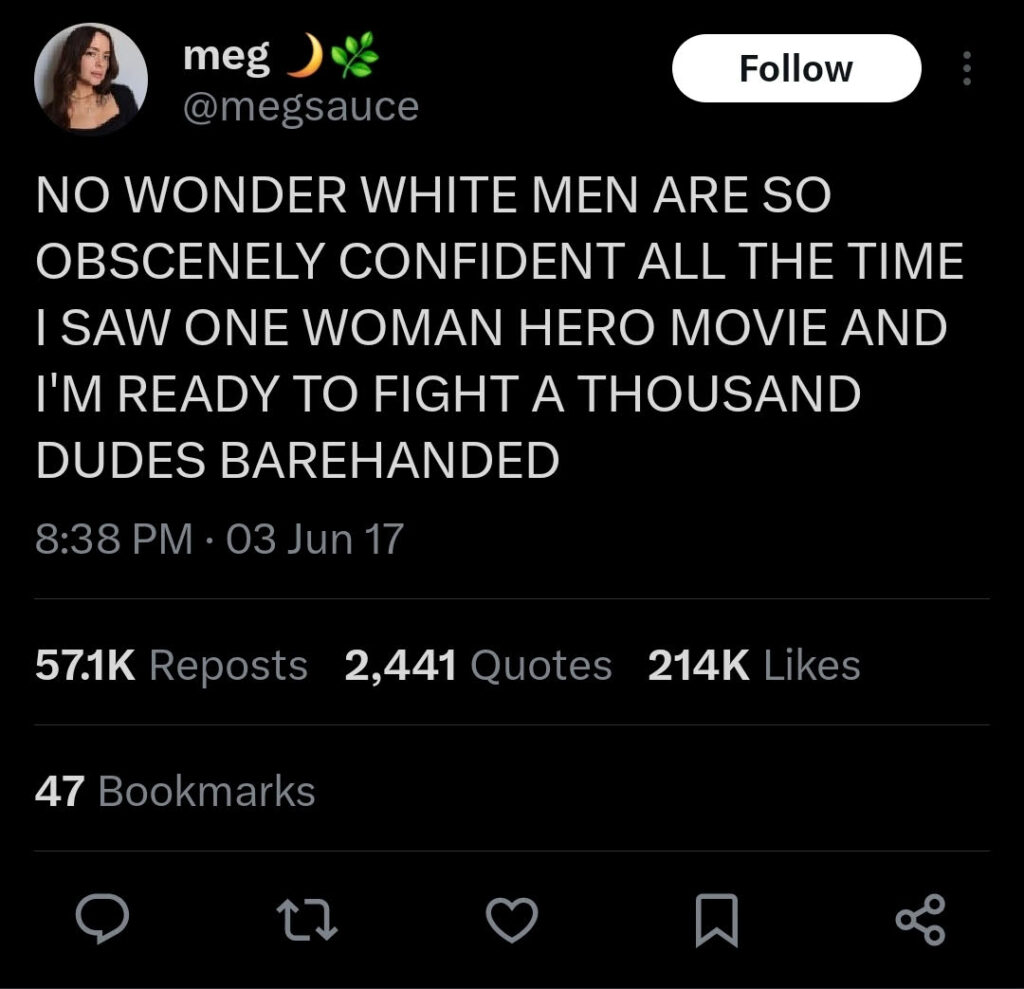
And that does bring us to a bit of a final question: Why do we have these movies? Why celebrate them? Why memorialize them? Why festivize them? Do they only belong to the shame vault of history, like those racist-ass Warner Brothers cartoons? Maybe. Maybe a little bit. One can’t help but notice that literally every single film I mentioned had a white male cisgendered lead character. That’s not something to ignore. But one of the things I always have to believe, a principle I stick to, is that media—and humanity—is always better served by sharing things rather than locking them away. So what do we do with this genre? I think this is a very important question: Do we fix things by getting rid of Weird Fantasy Violence to Set the World Right genre action movies? Or do we spread the love and appreciation and say the Machete and Mariachi movies deserve their place at the table of Wish Fulfillment Stupidity? Watch 70s Blaxploitation movies with the unstoppable justice-driven private eye who punches cops and seduces the mayor’s wife. They are cut from the same branch. Do we withdraw the movies where the white man learns his Stupid Confidence, or do we give everyone the chance for celluloid adrenaline straight to the brain and the 90-minute belief that someone who looks like them will Fix Everything? At least one fan of the first Wonder Woman movie thinks so, and so do I. Because when it comes to Cinematic Extravaganzas of Stupidity, Everyone should always be included.

A social media post by @megsauce, reading “NO WONDER WHTE MEN ARE SO OBSCENELY CONFIDENT ALL THE TIME I SAW ONE WOMAN HERO MOVIE AND I’M READY TO FIGHT A THOUSAND DUDES BAREHANDED.”

How Many Dinner Plates Is an Octopus Allowed to Take at an All-You-Can-Eat Buffet? - GHOST DOG: Way of the Samurai

 A Moral Interrogation of Cultural Appropriation & Judgements Thereof

One of the greatest and most delicious irrefutable gifts of the internet has been the ever utterly overwhelming and bottomless wash of media that is our every waking hour. Beneath every rock there are hidden worms—snacks that will sustain our artistic intellect. Algorithmic suggestions have led to no less than a dozen new favorite bands for me to blindside my friends with and reign supreme in my taste when I bring them things they haven’t heard of yet which blows their ears off just as much as they did to me, but I’m better than them because it happened to me first. You’re welcome, Eric.

But what about the other bits and pieces before those? What of the works and such that can be declared derivative, pablum, mediocrity? What of the trash we use to climb that mountain of aesthetic greatness? Do I owe The Last Samurai a thank you card for eventually having led me to Seven Samurai, Lone Wolf & Cub, Zatoichi, and Ghost Dog? I mean, yeah, obviously, but I’ve got 1300 words left to try to convince you that I’m right.

First, a note my heart tells me is worth a diversion: I’m aware the last thing the world needs is another several paragraphs from a white dude about what does or doesn’t count as cultural appropriation, but this is the topic at hand that’s gripped my muse for this month’s installment of “Free Movie Opinions from a Philosophy Major That’s Worth $Free,” and all I can say is that I hope you’ll bear with me until the end. Writing is fun, almost as much fun as reading is, and you should get to the end, if for nothing else than for the mental Double Dare challenge of it all I just threw down for you. I’ll lay down the law right now and say, yes obviously Halloween costumes are offensive if you’re dressing up like any culture—costumes are either a joke or a horror by definition—there’s no respectful way to wear a caricature of another human being. The zero thousand dollar question of this essay, however, is: are there entire art forms that can only be appreciated, enjoyed, or created “the right way” by “the right people”? Again, I say no, but I feel like this Ghost Dog movie created by a white dude about a black character using Japanese literature so he can work for an Italian mob boss seems like a good place to start.

Let’s go ahead and safely assume that a 18th century writer of a Japanese warrior how-to booklet like the Hagakure could not have possibly predicted it would end up in the hands of black man in an urban jungle who raises pigeons on a roof (I’d never met the authorial man in question from 300 years ago, but I bet he wouldn’t have predicted movin’ pictures either, so that all goes without saying). Just to immediately flip the coin—do you think H.P. Lovecraft could have predicted (or would have wanted) his CTHULHU stories to inspire a Japanese metal band like Ningen Isu, or a black sci-fi television show like Lovecraft Country? I can guarantee you that he would not (pro tip: do not google search what Lovecraft named his cat). Does white man Jim Jarmusch get a green light to make a movie with a black protagonist just because he asked RZA of the Wu-Tang to do the soundtrack? Maybe. Or maybe it’s like the World’s Greatest Author Chuck Tingle said; “Once an artist puts their art into this timeline it begins to change and bloom and grow in unexpected ways. That is the wonderful thing about the trot of a writer or painter or director buckaroo.” Do you think the Shaw Brothers planned on making all those Kung Fu movies just so RZA could use the sound effects and factually incorrect English language dubs made for American movie theaters in order to make hip hop beats? Have I made my point sufficiently with this many insufferable self-referential looped-back-in examples? It is all just art making art from art, which is the only way to ever make art (It gets extra twisted when you think about things like how mafia gangsters never started kissing each other’s rings until The Godfather II did it first and then they stole that ice-cold move from the movie into real life, but that’s another Ouroboros metaphor for another essay).

To lead back again to The Last Samurai, I am aware it is not a Great Movie. Did it absolutely blow my hair back when I saw it in theaters when I was 19? Of course it did. I am many stupid things but a liar is not one of them. It did not make me a Tom Cruise fan, but it did make me a samurai fan. Did I do that right? Did my inhalation of Kurosawa movies in my twenties somehow karmically redeem Edward Zwick? That seems a bit impossible and preposterous to try and measure, but somewhere in our media judgment, there must be a place for the Remedial Introductory Text. Whether it be in books, movies, plays, music—every new generation needs to be communally shepherded after that first unavoidable and bland introduction, not shamed for falling for simplicity first. Everyone is a child first. Simplicity is just the introduction. The aperitif. “Did you like that? Pretty great, wasn’t it? Well you’ll love this.” You can’t just start a kid on Sword of Doom and then call him a poseur because the ending made him cry. It’s nightmare fuel. There’d be no appreciation, and they’d sour to the beauty.

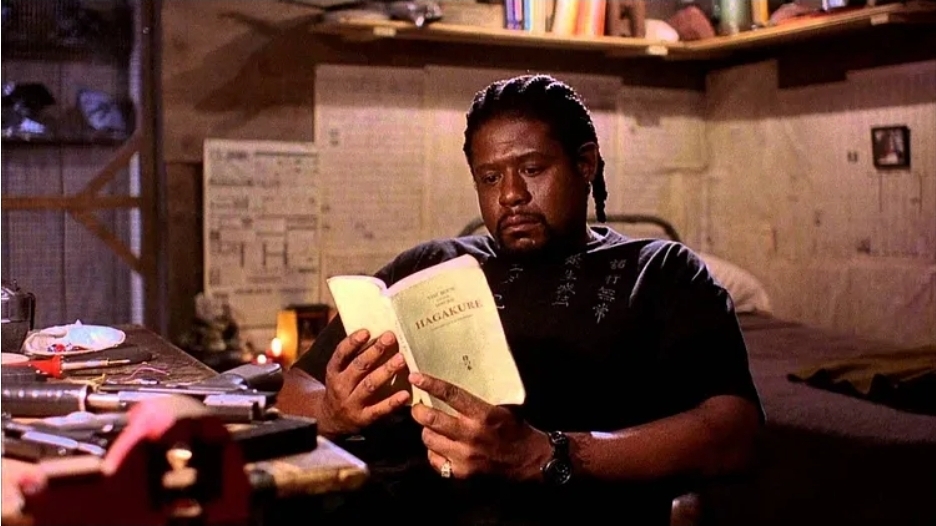
Ghost Dog reads from the bushido samurai text HAGAKURE.

There’s a wonderful scene in this film, when Ghost Dog is comparing literature with a little girl (who keeps her books in a lunchbox because books and art are literal sustenance DEAL WITH IT) because Jim Jarmusch knows and shows—not only by the pure act of making this cultural smorgasbord of a movie itself, but also textually rubbing your face in it in the actual film—that every human being is best served by letting them help themselves and gorge at the utter glut of all creativity ever made before they were born, and then letting them do literally whatever they want with it afterwards. At the end of the movie, Ghost Dog has given his copy of the Hagakure to this little girl, and you’re left with the question: is he sharing the violence in that book, or is he sharing the knowledge? Can you learn one without the other? Does Ghost Dog even get a say in how that plays out once he hands the book over? World’s Greatest Author Chuck Tingle knows the answer is no.

A work of art, placed in the world as a comfort to its creator, eventually (if it is blessed and lucky) strikes a chord with an audience that then looks to it for their comfort. And they can only express that love with more love. And the direction it flies and different shapes it births and births and births upon many births is just as unimaginable to the artist even one step removed from them as soon as they turn their back for even a second. Is Jim Jarmusch a fake try-hard because he likes black culture? Am I a racist hack because I write haikus before I fall asleep at night? Or did Jim Jarmusch and Ghost Dog soften me up for French New Wave Crime movies when I found those a couple years later? Is my life unimaginably more awesome because of Samurai Movies & The Spaghetti Westerns that Loved and Robbed Them? Are other people starving themselves because they think certain things “aren’t made for them”? The only thing you’re placing your art (or art appreciation) up against is emotional authenticity, either yours from day to day and work to work, or up against someone else’s work that they made. And more often than not, whenever you do that, you usually just end up looking each other in the face.

Ultimately, I believe that the final judgment of the work isn’t up to the work or even the work’s creator, it’s decided by us when we decide to take it into the future with us, in whatever shape or clothing we’ve decided to adorn it with for the case of the Chronological Bends to which we’re subjecting these beloved works that mean so much to us. Mutation is the sincerest form of flattery. We take them with us, and that’s the final priority and act of love and authenticity, just for me to shamelessly crib from Jarmusch himself:

Rule #5: Nothing is original. Steal from anywhere that resonates with inspiration or fuels your imagination. Devour old films, new films, music, books, paintings, photographs, poems, dreams, random conversations, architecture, bridges, street signs, trees, clouds, bodies of water, light and shadows. Select only things to steal from that speak directly to your soul. If you do this, your work (and theft) will be authentic. Authenticity is invaluable; originality is nonexistent. And don’t bother concealing your thievery—celebrate it if you feel like it. In any case, always remember what Jean-Luc Godard said: “It’s not where you take things from—it’s where you take them to.”

MADD MANN: Art & Aesthetic Appreciation in the Apocalypse of Avarice - DUEL

I’ve been writing haikus, lately. There’s something so completely stupid and perfect about every single one of them. They are utterly impossible to do incorrectly, as long as you can count to 17. It is an unmissable endeavor. It is a great gift granted to every human being that has ever lived, even the ones that couldn’t read. You don’t actually need to know how to read and write in order to write and read in your head. There is no greater equalizer.

I’ve been joyfully wrenching about a half-dozen of these stupid little dumplings out of my guts every night before I go to bed. Sometimes I get so excited with the whole endeavor that it’s hard to quit in order to actually fall asleep. It’s 1:30am Phil, jesus tiberius christ!

What would DUEL be in haiku form you ask? Only the first and most primal story we’ve ever told since we started telling stories: “I left my house and, something huge tried to kill me, thank god I survived” (17 syllables, child’s play, incredible). So why has this movie gripped my brain so hard that I felt like I had to write about it for you and me?

As an originally made-for-TV movie that went gangbusters and won full distribution (fun game: see if you can pick where commercials were “edited-for” in the film), it’s an interesting case study for the past, and it’s also a metaphorical clump of dirty tea leaves for us to read our future.

What’s first worth mentioning is that I had no knowledge of it until I knew about it. There is something so incredibly important about accidentally finding art where you did not expect it (think of what curated algorithm suggestions have stolen from us, but that’s another conversation for a longer essay). And DUEL, in fact, reminds me that the brain will never let itself be starved for art; it finds it where it has to find it.

Every human physical body needs to intake art. It also needs to create, to output, art. Everyone has a threshold minimum for both requirements. Nobody has a zero scale for either. If opportunity is not given, it will be taken. We are not only social creatures, we are creativity creatures.

Exhibit A for my defense, we have George Miller, Mad Max director and overall apocalyptic Cassandra who demanded that the cars in Fury Road be works of incredible personal expression, scrapped and welded by some of the most nefarious cinema villains ever created—“Just because it’s the wasteland doesn’t mean people can’t make beautiful things.” (1). I would personally add the emphatic that people also can’t stop making beautiful things. It borders on genetically imprinted compulsion.

There is no such thing as unskilled labor. Ever. Anywhere. There is always a smooth way to do whatever you are doing, and each craft has a master who has found the smoothest way to do whatever it is they are doing, no matter how pointless you might think it is. If you never knew These Hallowed Secrets at your job, you just weren’t paying attention (or your coworkers never liked you and didn’t tell you the tricks). We literally cannot help ourselves, we physically cannot stop doing and making cool shit. Even when we’re being forced to make money. Even when we’re being forced to make money for someone else. Call it efficiency distraction. A game to fight boredom. Homo Ludens—Human at Play. At every available opportunity. Your body needs to perceive art, to feed on it. If it is not provided, it will be hodgepodged.

You also need to know that art doesn’t become “not art” when it has commercials. Steven Spielberg didn’t “start making art” when he moved from TV to movie theaters. The locale makes no difference. Even commercials are art. We will not be stopped. Art doesn’t doesn’t become art when it makes money. It doesn’t become not-art when it loses money. It doesn’t matter if it costs money to make or to attend. Whatever art might be, I know the answer doesn’t lie in the price tag on either end of the process. I may not know art, but I know what doesn’t make it not art. I can’t define art, but I know it when I see it.

DUEL reminds me that art will sneak up on you. It will even exist and thrive beyond your perception, around dark corners that you can’t even see exist in order to see around them. Just because you have not noticed the art is art-ing does not mean it has not Art-ed, you adorable little main character of the universe, you. In fact, you’d be literally robbing yourself of personal development by trying to gatekeep what “counts as art.” Your loss.

We are surrounded, by paradise on all sides, you just have to look (17 beats, #blessings).

Very soon, we might have to (re)learn how to enjoy and make art without money, but we will never run out of time to kill and time to fill. Shakespeare in the Park performances, fountain architecture, street musicians, flash-mobs, stand-up comedy, shower singing, movie essays on free websites. Made for TV movies, from the 70s, 80s, 90s, and today. Even public look-alike contests drive my heart to incredible heights; “Hey we have similar facial features and costumes, it’s a good enough excuse to meet strangers.” Art. Period. Any human interaction or activity can be blessed with the patina of cool. Your brain will snap and Make A Big Deal Out Of It, if it wants to. Mine sure did, just for a movie about a dude in a car getting chased by another dude in a truck.

We turn every tool into a toy. And as already irrefutably established, play is art. You’d only need to see the incredible amount of art made by human beings who own smartphones (I was never on tiktok, but those people will still thrive, they will still exist). Are we to believe that they are quite literally unlike any other type of human being who has come before them, or are we just looking at a particular phenotype that has always been with us and is finally enjoying their place in the sun?

Art is everywhere. If it’s not, it’ll be placed everywhere, by some wonderful brain-starved maniac. And this art will be economically feasible to attend, or they will crumble and dissolve and die. And every affordable art form that we watch suddenly and horrifically get monetized right before our eyes, that will just make a different flat-broke art form spring up somewhere else.  And certain flat-broke audience versions will never die. And pirating art is always morally correct.* And supporting your weird independent local movie theater is always morally correct. And I’m not going to go so far as to say, “going in chaos-blind-ignorant to a movie (or any art experience) is always morally correct,” but I will say that it is one of the seven greatest activities you can do for your human soul and your mental intellect.


* Stealing is the goal of stealing an original, to the goal of personal hoarding, to society’s exclusion, of the item in question. Pirating is stealing a copy, ergo, not a crime. Only a crime in the false scarcity dystopia. This also, by de facto, makes library attendance a radical act.

References

1 Behind the Scenes – Cars : Mad Max : Fury Road

Sunday, January 26, 2025

HAUSU (1977)

A teenager's disembodied floating head leaps out of a water well and bites another teenager directly on her buttocks, with the camera holding for at least three full seconds on the whole frames image, like appreciating a work of art.

This is a Criterion Collection film.

With script assistance by an eleven year old girl (just adding to my theory that all children are soft psychos until social rules get a hold of them), HAUSU is literally unlike any other movie you have or will ever see. So much so in fact that attempting to use human typed words to convey the utter experience of it all is a quest in futility, but that’s really the fun part for me, so we’ll go ahead and wing it for the best try I’ve got in me.

The plot itself is not much. Seven teenage girls (Gorgeous, Prof, Melody, Kung Fu, Mac, Sweet, and Fantasy - yup) travel to the country to stay at Main Girl’s Aunt’s home, so Main Girl can avoid her new step-mom. Like every other horror movie ever made, going to any new house is obviously a guaranteed death sentence (also, ironically, leaving the house in every horror movie is also a death sentence - those subtextual genre themes get you no matter where you turn, huh?), so I don’t think it’s spoiling anything to let you know that things go very poorly for our heroines. My job in this essay though is to try and convince you of my personal belief, that this movie rules so hard that it borderline justifies the very medium of film as a whole. That Tarkovsky’s quote that “films are a mosaic made of time” is especially true in this visual tale where a piano eats a girls hands, a fat schlub turns into a pile of bananas, a house fills to the brim with menstrual blood, and it’s all some of the funniest things you’ve ever seen in one of the creepiest movies you will ever watch. A friend once described it as “a Japanese Evil Dead,” and I’ll admit that’s the quickest elevator pitch definition I’ve found so far. And Evil Dead is good, but we’re not talking about Evil Dead right now, we’re talking about Hausu.

And I think Hausu is also very good. But those two cinematic measurements are mere subjectivity - I think Hausu rules, you might want to beat me up after wasting 90 minutes of your night and visiting you with a lifetime of watermelon eyeball teeth nightmares. But it’s more than just the pure organized queued up assault of One Weird Thing After Another, as Evil Dead & Hausu do have in spades. There are aspects of the horror here that are only able to be conveyed by the act of film, and editing. This enters into the actual point I began - what is it about Hausu that not only lends itself to film, but in fact would be lost if it were not a film?

First and foremost, is the challenge of the Viewer’s Imagination. That old chestnut - “leave the monster off the screen, we’ll just let the audience’s imagination do the work for us” - does in fact work like gangbusters most of the time, if we’re dealing with one monster. A shark, a xenomorph, a dream murderer, a drowned kid who can’t die, a werewolf, dracula, whatever. What do you do when the monster is the house? You have nowhere to hide, but also the director can’t hide anything. But here you have the caveat, perhaps the asterisk, to the “Hidden Monster” trick - what you might call The Carpenter Thing Clause - “what if we made a monster that was so goddamn gnarly that we came up with something the audience never could? That’s our job, let’s act like we’re getting paid for it.” Hausu is that in spades, co-written by an 11 year old girl who doesn’t yet know what you “can’t do” in a movie. It is a visual feast, and you will leave the theater disappointed by other horror movies that don’t try half as hard. I’m sorry, I know, I’m cursing you. Like Nicole Kidman always says, “We come to the movies to get absolutely blown-out diaper-dump scared while a piano eats a screaming teenage girl alive.”

The question, again, though, is why is it a movie? I would submit that it has to be a movie, in order to get everything out of it. In order to squeeze every ounce of creativity that is being visited upon you.

Horror is obviously a thing in novel form (shoutout to my main man Poe) but not this story. You could not merely read about the spindly handicapped woman climbing the rafters and breaking the 4th wall to threaten you with eye contact before she destroyed these children - if she is in the book, she is in the book. The characters may not be safe, but you always are. You could threaten an audience in a play, sure! You could even come out of the stage and enter the seats - horrifying in any context! Even Oklahoma! - but you still could not edit a play, it is only forward motion. Movies are rewound, sound is rewound, your eyes are not your eyes, the camera owns those eyes. “I don’t want to look at that” - too bad you are looking at it! It is a full package.

Furthermore, the act of layering audio and visual over each other, which is purely a cinematic tool. And the montage of the old woman’s life before the war, done play-by-play commentary style with the girls doing voiceover - to convey how absolutely creepy this women’s life was that she’s fiendishly and horrifically preserving, voiced over by 7 girls who mention that the nuclear bomb mushroom cloud “looks like cotton candy” (which would be like saying 47 9/11 buildings “looked like a banana peeling itself”) which only just reinforces how these girls are oblivious and out of their depth. You can do both of these things simultaneously. You cannot simultaneously read things that are happening simultaneously. I know, because I’ve read the books that have tried (I read William Faulkner, and Ulysses & Finnegans Wake, so you don’t have to - you’re welcome, you’re right, I am a hero).

There are, of course, innumerous movie & non-movie examples of the horrors that this film uses as its horrors. Greatest hits, like “cultural (and personal) preservation is inherently creepy,” the difference between love & obsession, the fear of aging, the fear of maturing from girlhood into womanhood - but none of those other lesser mediums can do that with the tools of cinema - the act of footage being played in reverse to add to the nausea of her delusion of the youth she lost, to have a character be eaten alive by a grandfather clock full of teeth, or the visual metaphor of the floating legs of a woman who’s been chopped in half still kung-fu-ing across the room to karate kick a painting of an evil white cat & the house fills to the roof with menstrual blood. Such subtle subtext. You can convey all that in words (in fact, I just did, high five me), but the passage of time, which passes through each verb or adjective or adverb or whatever, that only elongates the experience of the horror, which is a factual matter of diminishing returns. If every word to describe a scene takes another tenth of a second, it will be surpassed when 6 frames give you the most unhinged and hilarious visual fever dream you’ve ever seen in 6/24ths of a second running in reverse. It’s not like you can’t make a novelization of Hausu, but why would you? It already existed first in its greatest and final Akira form.

There are books that must be books (good luck making a good TV or movie version of Gravity’s Rainbow), there are shows that must be shows, but there are also movies that can only be movies. And in fact we are a better world for having movies, and Hausu is my Exhibit B for that fact, for the entire medium of films as a whole (behind only Godzilla, which is literally the reason 60 foot theater screens were ever invented - there is no “book version” of Godzilla, except Moby Dick, the only novel about fighting a Kaiju in the Canon of Western Literature there will ever be, because there will never be another Melville, don’t @ me). The same is to be said with Hausu. There are visual gags & horrors that would be lost if it was not filmed. Editing and color bleaching and images that you could describe in a book, but why would you?

There are many other worlds where HAUSU still exists - as any form, a poem, a screenplay, a painting, a post-it note flip book - but the best of all possible worlds is ours, this one, where this film exists, as a film.


Published at the Trylon Theater Blog - PERISPHERE